Hands up if you’re satisfied with the position that there is no evidence that pesticides do not cause long term harm.
Reply
Hands up if you’re satisfied with the position that there is no evidence that pesticides do not cause long term harm.
You may have seen a 38º petition to block Syngenta’s attempts to get round the moratorium on certain insecticides.
Professor David Goulson, insect expert and enemy of pseudo-science, psychobabble and marketing bullshit offers his considered view in his latest blog.
If you haven’t seen the petition, you can find it here.
Interesting article here about the benefits of raw honey for diabetics.
I’m no medical practitioner and I’m making no claims, either, but it seems to me that diabetics need to control all carbs.
However, if honey can be used more easily, then it would be better to substitute this for some of the things diabetics crave and which they know do them no good.
I have been inundated with demand from hay fever sufferers for my Seven Kings honey.
Many have found their antihistamines are not working with the current high pollen levels and have turned to local honey to alleviate their symptoms.
Many of them have told me symptoms improve, though some of my other customers have told me they need to start taking honey before the hay fever season for it to be most effective.
If you’re a sufferer, what has been your experience? Post your answers below.
 The BBC is to film two 60 minute shows into the world of honeybees, hosted by wildlife everyman, Chris Packham and wannabe but allergic beekeeper, Martha Kearney.
The presenters will be joined by bee expert Professor Adam Hart for Hive Alive, which will explore the remarkable lives of honey bees.
The (mini) series will present “a lively television event which will reveal the world of the honeybee as we’ve never seen it before”, says the BBC Media website.
“Cutting edge technology, exciting new experiments and an army of bee experts will help us discover just how amazing these insects are and what we can do to help them to help us.”
Which, given the way spring/summer/autumn/winter/allpointsinbetween watches have gone probably means we will have to put up with expensive, useless experiments and graphics delivering dumbed down nonsense that most six year olds will find patronising.
But hey, it’s more bees, so that’s got to be good for another 50p on my jars of honey.
In all seriousness, it’s great the BBC has backed Kearney in this, but I fear they’ll drop it like a difficult subject in Eastenders once they’ve wrung the viewing figures out of it.
The series will be shot by Impossible Pictures, the makers of Walking with Dinosaurs, but there is no published transmission date as yet.
More details at http://www.bbc.co.uk/mediacentre/latestnews/2014/hive-alive
“Where do your bees collect nectar and pollen from?” is a question I’ve been asked a lot recently, and it’s a good question.
Nectar is what bees turn into honey by adding special enzymes to it and reducing the water content. This is their staple food stuff. Pollen is collected as a source of protein to feed young bees.
Honey bees will travel up to three miles to forage on plants, collecting nectar and pollen as they go. It takes the lifetime of 12 bees to make one teaspoon full of honey, so you can see how much work goes into making honey and why it has been prized by man throughout history.
The map below shows a circle with a three-mile radius to give you an idea of the kind of ground my bees will cover to collect honey and pollen. This covers gardens, allotments, parkland, pasture, golf clubs, river banks, railway lines and even a bit of farmland. This means the honey will be a mix of whatever is in greatest supply at the times the bees store it.
As a result, the colour and flavour of the honey can be different at different stages of the season. But I can assure you – it’s all equally delicious.
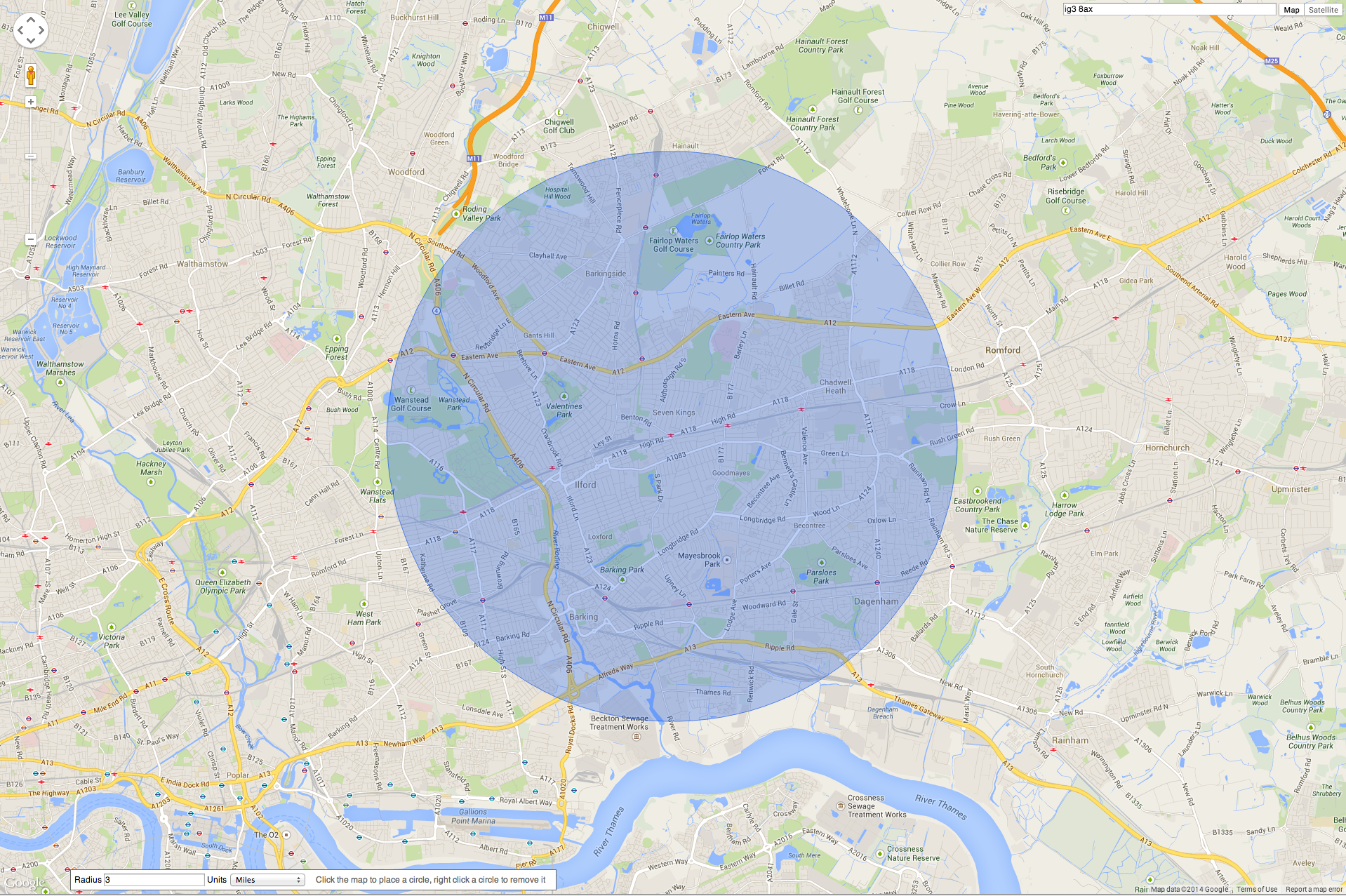
Map shows a circle of three mile radius. Bees will generally travel up to three miles to forage, which is anywhere in the circle, starting at the centre.
 Seven Kings Apiary is pleased to announce it has been awarded the highest food rating score of 5/very good.
“The top rating of ‘5’ means that the business was found to have ‘very good’ hygiene standards,” according to the Food Standards Agency’s website.
Seven Kings Apiary (SKA) registered with Redbridge in 2013 and went through the inspection process. Though honey is classed as a low risk product, SKA wanted to be able to show it’s customers (and the council) the product was handled in a hygienic environment.
The award was made in August 2013, but due to a bit of a cockup somewhere along the line, SKA didn’t receive its notification until this June 2014.
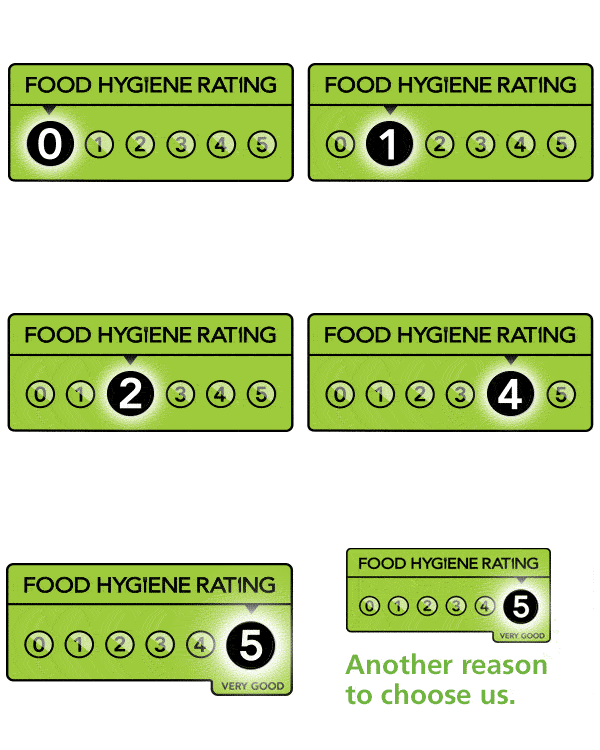
Pádraig Floyd, the hobbyist beekeeper who runs SKA, said: “It’s great to be able to show our customers that despite being a cottage industry, we have their safety at heart.
“Our customers can not only be assured of a superior product as all local, unadulterated honey is, but that we maintain high standards of hygiene in processing it.”
 Seven Kings Apiary